Tuesday, August 08, 2006

Review: The Arrogant Princess (Teochew Opera)

Title: The Arrogant Princess (打金枝)
Genre: Teochew opera (潮剧)
Format: Stage opera
Production year: Around late 1990s to early 2000s
Director: Chen Wei
Music: Chen Dengmou
Scenography: Lin Xichong
Casts: Xu Shu'e as Gui Ai, Hong Liqing as Princess Junrui, Chen Lianzhong as Emperor, Lin Yanfang as Empress, Lin Roujia as Guo Ziyi

At first glance...

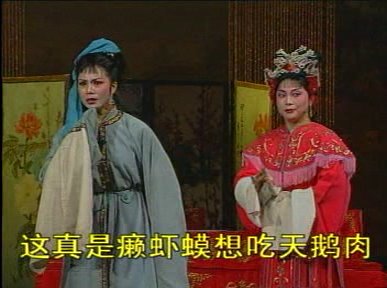
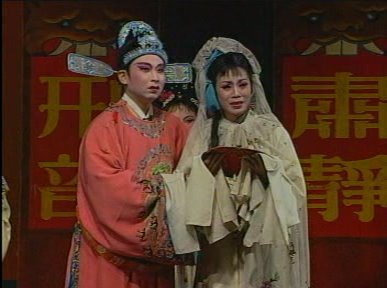
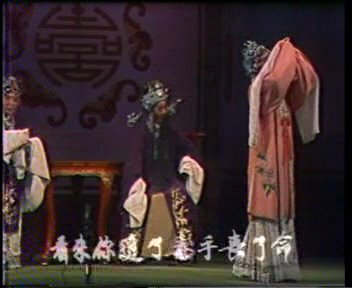
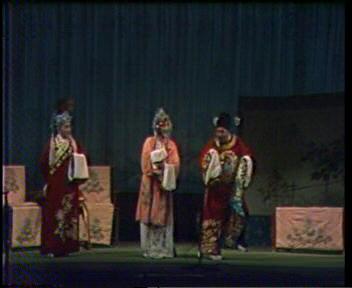
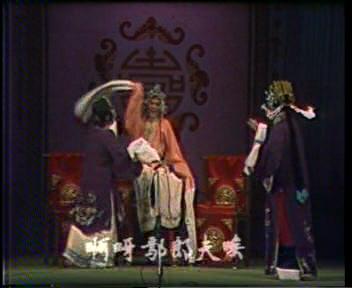
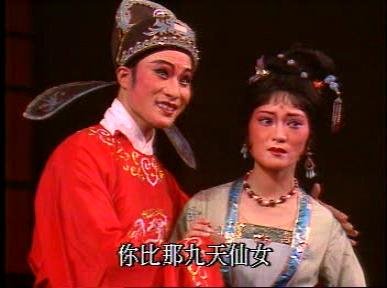
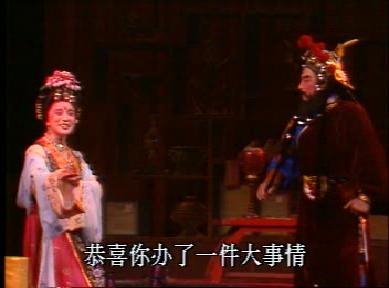
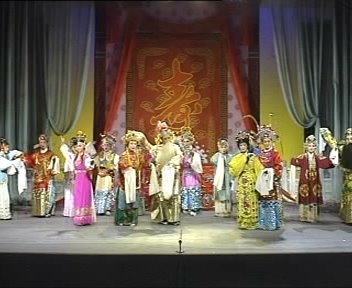
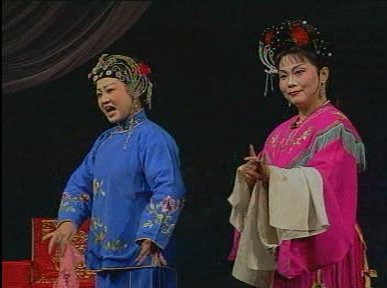
"The Arrogant Princess" is a well-known folk story which had been acted out in various Chinese opera genres. The highlight of the show lies in the scene whereby the Princess consort gives the Princess a tight slap for failing to observe her role as a filial daughter-in-law, something which in ancient times is a taboo act to be carried out to a member of the royal family. This show was staged by Jieyang City Chaoju Opera Troupe .

Synopsis
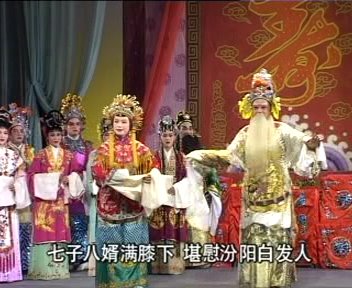
On the 70th birthday of Guo Ziyi (Duke Fenyang), all his sons, daughters and their spouses turned up to celebration, except for the wife of Guo Ai, Guo Ziyi's sixth son. Guo Ai's wife was Princess Junrui, and she refused to turn up as she believed that it was against the norm for members of the royal family to pay respect to their subjects. Guo Ai's fifth sister-in-law was a straight-forward person, and she mocked Guo Ai for bragging earlier that the Princess would sure come. This angered Guo Ai greatly, and stormed back to his residence to reprimand the Princess.
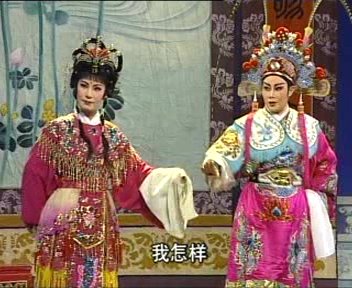
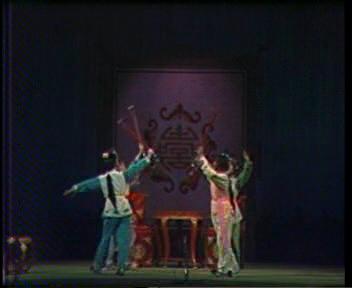
Meanwhile, in the residence of the Princess consort, the Princess was feeling moody with Guo Ai not by her side. When she heard that her consort had returned, she asked the palace maids to hang up the red latern. This hanging of red lantern was a practice of the imperial palace, and the red lantern served as a granted permission to enter the room. On seeing the lantern, Guo Ai grew more furious, and he had the lantern smashed. The Princess was suprised by Guo Ai's action, but did not realise that it was her who had made him angry. Guo Ai confronted the Princess for failing to turn up for his father's birthday celebration, and she insisted that she was not in the wrong for not bowing down to her subject. A heated argument between the couple soon broke out, and Guo Ai gave the Princess a tight slap in the end.

Unable to stomach the humiliation, the Princess decided to lodge a complain to the Emperor, and even made up stories that Guo Ai had abused her with she suffered injuries all over her body. The wise Emperor knew this is just a small squabble among the young couple, and decided to give the Princess a scare by pretending to get furious and "sentence" the consort to death. This shocked the Princess greatly, and she regretted her earlier actions. However, despite her pleadings, the Emperor was determined to pass the sentence.

Meanwhile, Guo Ziyi had found out about what Guo Ai had done. He was furious, and had him arrested and brought to the imperial court to surrender to the Emperor. The Emperor was impressed by Guo Ziyi being impartial in this matter. He forgave Guo Ai on the spot, much to the relief of Guo Ziyi. However, he still reprimanded Guo Ai for losing his cool and showing defiance towards the Imperial rules. The Emperor then led Guo Ai back to the inner palace to meet the Princess. After much coaxing from the Emperor and Empress, Guo Ai and the Princess fnally patched up. The Emperor even gave Guo Ai permission to use his hand again if the Princess ever gets wilful again. All's well ended well, and the young couple went over to Duke Fenyang's residence after their reconciliation to pay their over-dued respect to Guo Ziyi.

Review
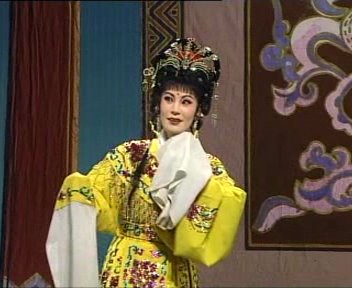
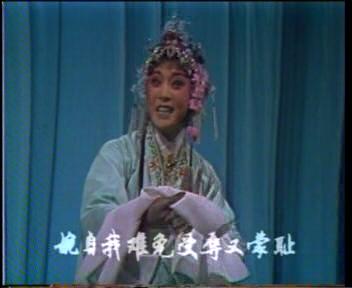
For traditional shows like this, I do not expect much from the script, as long as they do not go out of point, it is acceptable for me. For this production, the plot was concise enough, without having to go into unneccesary details like what some other productions I've seen before. Jieyang City Chaoju Opera Troupe is a relatively unknown troupe to me, but the standards of their performance is quite good. The 2 leads managed to portray the role of Princess Junrui and consort Guo Ai well. One particular point that I want to bring out is the role of Princess Junrui. This role is rather complex; she is wilful, but not in the sense of being spoilt and stuck-up. To my understanding, she is a lady who is well-taught in rules and customs, just that she failed to apply them in good use, and in this case, paying respects to her in-laws. Hong Liqing managed to capture the feelings of the Princess correctly, but it'll be better if she could "act cute" a bit more. Xu Shu'e's performance as Guo Ai is competent. She managed to balance the serious side of a Princess consort and the imprudent side of young Guo Ai well, without over-doing in either way. The other supporting roles were acted out well too.
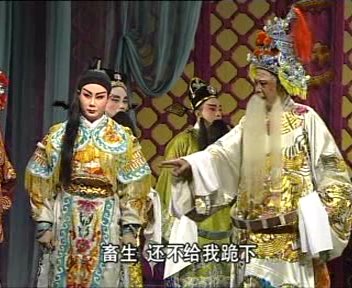
As for the costumes and character portrayal, there were areas which I don't quite fancy. First, most of their costumes are actually sewn with sequin, making the design of the costumes look harsh, and at times "out-of-fashion". As for character portrayal, the actress assuming the role of Guo Ziyi's wife looked too young to me. When standing beside the wrinkle-faced Guo Ziyi, Madam Guo's face was too smooth, and her hair were all black. She should be of the same age as Guo Ziyi! Another character I wasn't too satisfied with it's portrayal is the role of Empress. Somehow the overall packaging just doesn't give me the feeling that she's the Empress, although she wears a big phoenix hairpiece on her head, and her costume was embroided with phoenixes.
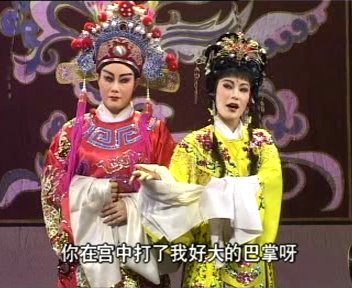
I like the way the show was directed. There is a particular segment of the show which I rather like, whereby after the young couple patched up, Guo Ai invited the Princess pay respects to his father, but the Princess "refused", and Guo Ai "threatened" to slap her again. Of course, Guo Ai did not land his hand on the Princess again this time round. It's a lovey-dovey act which makes their reconsiliation look more complete. Most other productions only ended at the point where the Princess and her consort patched up. Another part I like is the part whereby the Emperor gave Guo Ai the permission to use his hands on the Princess if she were to become wilful again, and Guo Ai showed the Princess his fist to show his dominance over her.

On the whole, I feel that this show is not too bad. However, if not for the cast and the director's directing sense, I think this show would be a bore to watch.


Ratings


Script

Music

Scenography

Casts

Final rating

Tuesday, May 16, 2006

Review: The Mute Lady's Lawsuit (Wuxi Opera)

Title: The Mute Lady's Lawsuit (哑女告状)
Genre: Wuxi opera (锡剧)
Format: Stage opera
Production year: Around late 1990s to early 2000s
Director: Chen Jian
Music: Yuan Yao
Scenography: Yang Yuan
Casts: Zhang Meihua as Zhang Shangzhu, Wang Weihong as Zhang Saizhu, Qian Ke as Chen Guangzu, Yang Longhua as Dai Da, Huang Qiuwei as Madam Zhang, Qin Xing as Zhang Zhong

At first glance...

"The Mute Lady's Lawsuit" is a rather famous show in the Chinese opera scene, and so far, Huaiju opera (Jiangsu), Jinju opera (Shanxi), Bangzi opera (Hebei), Huangmei opera (Anhui), Qiongju opera (Hainan), Xiangju opera (Fujian), Chaoju opera and Cantonese opera (Guangdong) had already staged their own version of the same script. Hence, it would be interesting to see how will Wuxi opera, one of the 3 major Chinese opera genres in Eastern China, make this their own traditional show. This show was staged by Suzhou City Wuxi Opera Troupe.

Synopsis

This story took place in Yangzhou during the Ming dynasty. There was a Zhang's Residence whereby one of the towers was rumoured to be "haunted", causing unrest among the household members. The "haunting" was actually fake, and the "ghost" living within was a poor scholar by the name of Chen Guangzu. He was betrothed to Zhang Shangzhu, the eldest daughter of the late Master Zhang. Chen used to come from a reputable family, but ever since his parents' death, his family was reduced to poverty. He tried to take refugee with the Zhang's, but Shangzhu's stepmother looked down on the former, an chased him away. Kind-hearted Shangzhu decided to take him in, but had to hide him inside the tower to avoid suspicion.

After Guangzu left the Zhang's to pursue his imperial examinations, Madam Zhang tried to force Shangzhu into another marriage. Shangzhu refused and was locked up in the "haunted tower". Not long after, news of Guangzu's promotion as the top scholar reached Madam Zhang and Saizhu's ears. Saizhu, the stepsister of Shangzhu, had always dreamt of becoming a nobleswoman one day, decided to forge her sister's identity and marry Chen. In order to prevent unexpected twist of events in future, Madam Zhang decided to kill Shangzhu by ordering her retarded son Dai Da to burn down the "haunted tower".

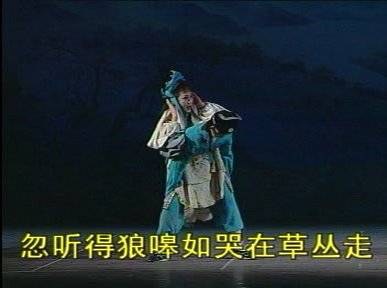
Meanwhile, loyal servant Zhang Zhong had revealed the truth about Saizhu's plot to Shangzhu. Shangzhu was shocked by the deeds of her stepmother and stepsister, and decided to sue them in the imperial city. However, before she could sneak out, the tower burst into flames. Shangzhu escaped from the clutches of Death by jumping off the balcony of the tower, but became crippled. Dai Da realised that he had been tricked into burning down the "haunted tower", and decided to nurse Shangzhu back to health in a secret cave in the garden. With the help of Zhang Zhong, Dai Da piggy-backed Shangzhu all the way to the imperial city to look for Chen.

Saizhu got news of their arrival in the imperial city, and hence tricked them back to her residence.In front of her stepsister, Saizhu pretended to be remorseful for her actions, and tried to beg "forgiveness" with a toast of wine. Shangzhu was not in the mood to drink, and Dai Da drank the wine on her behalf. Little did they know that the wine has been drugged, and that Saizhu had actually intended to poison Shangzhu. Dai Da was poisoned to death in the end, and Saizhu muted Shangzhu by stabbing her in the neck repeatedly with a hairpin. She even crushed Shangzhu's fingers so that she could neither talk or write in court.

Despite her disabilities, Shangzhu was determined to sue her vicious stepsister. She was finally granted entry to the magistrate's court, and the magistrate was none other than Chen Guangzu. Chen, who had actually not seen Shangzhu's true face previously (they always meet in the dark), was shocked with the close resemblance of Shangzhu to his "wife". At this juncture, Saizhu turned up and accused Shangzhu for being a crasy woman and demanded her to be executed at once. Chen began to doubt the identity of Saizhu, and she was nowhere close to the elegant and gentle Shangzhu he once knew. Loyal servant Zhang Zhong turned up pleading innocence for Shangzhu, and after gathering all her strength, Shangzhu finally managed to speak. She revealed the entire truth to Chen, and the latter was shocked. He then sentenced Madam Zhang to life-imprisonment and Saizhu to be executed immediately.

Shangzhu was finally reunited with her loved one, but she decided not to don the rainbow robe and phoenix crown which was bestowed to her, as she wished to mourn three years for her poor brother...

Review

As far as the script is concerned, it lacks originality, as I vaguely remember the Huaiju and Xiangju version of the same show beared the same dialogues and lyrics (but of course with some differences to suit the dialects). Like typical traditional shows, there were obvious flaws in the logic of the show, but were not resolved. Like in scene 2, where Madam Zhang forced Shangzhu to marry a high-ranking official, the script doesn't explain why the former had done that. Normally a stepmother will want the best for their own children first, and a high-ranking official sounds like a good "catch", so why didn't she want to "reserve" the marriage for Saizhu instead? Unless he has got other undesirable traits, then it would be another story, but it wasn't mentioned. And point in the same scene was Saizhu was so decisive im marrying herself to Chen when she heard that Chen had became a top scholar. However, earlier on in the scene, she was dreaming of being the Emperor's concubine, and even become the head of the concubines. The sudden drop of "goal" was too abrupt and awkward.

The music was another awkward issue. It is very clear that the music were all pre-recorded and then actors sing to that on stage. This was made more obvious by the difference in sound quality of live percussion used in non-singing/ non-music parts of the show.

The casting for this show were average. Of all the actors, only Zhang Meihua, who took on the role of Zhang Shangzhu, really caught my attention. She was graceful on stage, looked great, and could sing well. The other actors' singing were not bad too, but did not fare as well in other aspects of their performance. For Qian Ke (Chen Guangzu), he lacked emotions, and his shen duan was average. Wang Weihong's rendition of the vicious Saizhu was good, but she seemed a bit too old to be the younger sister of Shangzhu. In fact, it seemed like none of the actors in this show are young.

Back to Zhang Meihua, though her performance in general was good, her performance in scene 6 ("Journey to the Imperial City") was disappointing. This is the essence of the show, regardless of the genre, as the actor taking the role of Shangzhu has to perform solo with a "piggy-back doll". This is no easy feat, and the actor will have to act 2 roles simultaneously; a dan from waist up and a chou from waist down. Zhang Meihua's huadan gestures were good, but when it comes to chou movements, it was really average. The quality of this scene was aggravated by the quality of the "piggy-back doll", as the doll was already in a bad-state, and looked more like a zombie, rather than a life-like man.

On the whole, I feel that this show could have been better executed, but too bad too much of the original script was preserved. It might be good to maintain the traditional aspect of the script, but I think some irrelevant and illogical parts still must be changed. Time has changed, and the audience's level of thoughts has changed as well, so do not expect modern audience to readily accept whatever you throw at them!

Ratings


Script

Music

Scenography

Casts

Final rating

Sunday, April 30, 2006

Just One Look : The Look That Wowed Audiences 3

In this third part of the series, I've attached a clip of Wuxi opera, "The Pearl Pagoda" performed by the Wuxi City Xiju Opera Troupe.


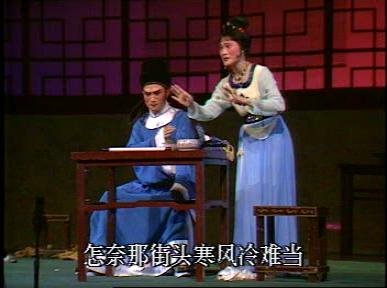
"The Pearl Pagoda" tells the story of a poor scholar Fang Qing, who was actually the descedant of the late primt minister, was shunned by her paternal Aunt when he turned up on his uncle's birthday feast to seek financial assistance. She even mocked him by saying she would carry an incense altar over her head to welcome him if he ever make it big in future. Fang Qing felt insulted and was about to leave but was stopped by his cousin Chen Cui'E. Miss Chen had always liked her younger cousin, and in order to aid Fang Qing, she decided to present her family heirloom, the Pearl Pagoda, but disguised as a box of cakes. Miss Chen's father found out about the whole incident and decided to chase after his nephew and had his daughter engaged to him. On his way back home, Fang Qing was was robbed of the Pearl Pagoda not long after by a robber and left to die in the wilderness. However, luck was on his side as he was later saved and topped the imperial examinations 3 years later. He decided to return to the Chen's residence under disguise as a examination drop-out to test his aunt. Fang Qing's aunt realised her follies, and accepted Fang Qing as her son-in-law to compensate for her short-sightedness.

Featured here is the second scene of the show, "Fang Qing Meets His Aunt". Acting the role of Fang Qing and Fang Duohua (Fang Qing's aunt) are Pan Peiqiong and Guo Zhihong respectively. The actor of particular interest to me in this scene is Guo Zhihong. Her portrayal of the snobbish and mean aunt was very comical, yet not diminishing the grace and airs of a nobelwoman. Especially so since this is first time she has been taking on a laodan role! (She used to be a xiaodan and huadan of the troupe)

Sunday, April 23, 2006

Review: Righteous Yan Lanzhen (Shaoxing Yue Opera)

Title: Righteous Yan Lanzhen (盘夫索夫)
Genre: Shaoxing Yue opera (越剧)
Format: Stage opera
Production year: 1981
Director: Huang Sha
Script rearrangement: Xu Jin (Pan Fu), Chen Yu, Huang Sha and Su Xue'an (Suo Fu)
Music: Li Zichuan
Scenography: Gu Daliang
Casts: Jin Caifeng as Yan Lanzhen, Lu Jinhua as Zeng Rong, Qian Miaohua as Yan Shipan, Zhu Juxiang as Zhao Wenhua, Yu Meidi as Zhao Wanzhen

At first glance...

“Righteous Yan Lazhen” is a traditional show of the Shaoxing Yue opera. Because this show is so traditional, some people may find that it has a very strong hint of Peking opera. The Chinese title of this show may sound weird and meaningless, but it is actually the combination of two excerpt titles, “Yan Lanzhen Interrogating Her Husband” (Pan Fu) and “Yan Lanzhen Searching for Her Husband” (Suo Fu). Both excerpts formed the storyline of this show. Taking on the role of Yan Lanzhen is veteran actress Jin Caifeng, the founder of the Jin-styled singing. She was known for her vivid portrayal of this role.


Synopsis

During the reign of Emperor Jiajing of Ming dynasty, son of upright official Zeng Rong was on the run after his entire family were killed for trying to oppose villain Yan Song. He was subsequently being adopted as god-son by Yan Song’s accomplice Yan Mouqin, and married Yan Song’s doted granddaughter Yan Lanzhen. However, their marriage was not totally a happy one; throughout the first month of their marriage, Zeng Rong had been sleeping in the study room, and had never stepped into Lanzhen’s room before. Lanzhen could not understand the reason for Zeng Rong’s coldness towards her and decided to invite him over and ask him directly. After persuading Zeng Rong that he should confide in her in whatever matters he had, Zeng Rong found that Lanzhen was a virtuous lady and should have faith in her. However, just as he was about to disclose his secrets, he was suddenly reminded that she was after all the daughter of her enemy. He stormed out of Lanzhen’s room, leaving Lanzhen feeling mystified. She felt that something was not right and decided to go over to Zeng Rong’s room. Outside his room, Lanzhen overheard Zeng Rong talking to himself, and discovered his true identity. She was saddened by Zeng Rong’s misfortunes, at the same time angry over the misdeeds of his father and grandfather. After some self-thought, she decided to stand by her husband. Zeng Rong realised his foolishness in regarding his wife as an outsider and the couple finally reconciled.

Days later, Lanzhen’s father Yan Shifan sent a memo over, stating that it was her mother’s birthday and request the couple to turn up for the celebration. Lanzhen could not go as she had just got married and was not supposed to return home. However, she asked Zeng Rong to go alone instead, but reminded him not to drink too much so as not to invite trouble. Over at Yan Shifan’s mansion, Zeng Rong could not reject constant wine-toasting from his father-in-law and decided to feign drunkenness. Yan Shifan hence got his steward to bring him to the guest room for a rest. Zeng Rong tried to sneak out of the mansion, but accidentally stumbled upon the study room which Yan Song used to write petitions and thesis. He thought that he might be able to find some evidences against the Yan family, and hence decided to sneak inside for a look. Meanwhile, Zhao Wanzhen, daughter of Yan Shifan’s good friend Zhao Wenhua, was having a stroll in the Yan mansion’s back garden when she heard noises coming from the study room. She then got her maid to go and take a look. Wanzhen’s maid realised that it was Zeng Rong, and advised him to get out quickly as the study room was a restricted area and trespassers will be executed straight away. However, there were many guests outside the study room and they were unable to leave. The maid then suggested that they take refuge at Zhao Wenhua’s mansion instead, which was just next to Yan Shifan’s residence and can be accessed from another exit of the study room.

Meanwhile, Lanzhen began to worry about her husband’s safety when he failed to return by dusk. She had her maid to go and fetch him back on two occasions, but the maid was told different stories each time; Yan Shifan told her that Zeng Rong was taking a rest at the guest room on her first visit, while his wife told her that he had went back already. Lanzhen began to get suspicious and decided to go over to her father’s place with her bunch of maids to demand the return of her husband. Back at Yan Shifan’s mansion, both Lanzhen’s parents could not account for Zeng Rong’s whereabouts, and Lanzhen quickly jumped to conclusion that her father had killed her husband. She started to create a big din in the mansion, and even ordered her maids to smash all the lamps and decorations in the mansion, much to the horror of her parents. Yan Shifan may be a much feared villain in the imperial court, but he was afraid of his daughter as much as how other officials were afraid of him! He quickly got Zhao Wenhua over to try to appease his daughter. However, on seeing him, Lanzhen immediately accused him of trying to collude with her father to dispose Zeng Rong’s body. She then ordered her maids to go ransack Zhao Wenhua’s mansion instead.

At Zhao Wenhua’s mansion, Wanzhen told Lanzhen about Zeng Rong’s whereabouts, and after Zeng Rong explained the entire situation to his wife, Lanzhen thanked Wanzhen for saving her husband, and in order not to ruin the reputation of the latter, Lanzhen accused Zhao Wenhua for locking Zeng Rong up in his daughter’s room, and forced him to write a statement that he was solely responsible for all the problem caused, and had nothing to do with Wanzhen. Zhao Wenhua had to oblige, and the couple returned happily.

Review

As introduced earlier, this show is a traditional show for this opera genre, and one can see that for themselves; the costumes and hairdo of the characters were heavily influenced by Peking opera. Leading roles will have to recite a poem once on stage, and also declare their identity aloud to audience, just like traditional Peking opera shows. Not only that, the stage set was very simple and basic, a typical Peking opera characteristic. Due to these factors, non-Peking opera watchers might find this show a bit tough to watch.

Another reason that might deter audience from watching is that the plot of “Pan Fu” was very simple, and more emphasis was placed on singing. In fact, many lines of this excerpt were repeated (Zeng Rong sang about his real identity to himself, and Yan Lanzhen sang the same lines again later on to Zeng Rong, to hint him that she already knew his identity).

“Suo Fu” was a much better excerpt to watch in comparison, as it has a more interesting plot. The last 2 scenes were especially funny, when Yan Lanzhen "terrorised" her father's mansion with her gang of "iron ladies" when her father could not explain why Zeng Rong was missing.

The cast for this show were all veteran actors from Shanghai Yue Opera Company. The female lead, Jin Caifeng, really lived up to her name for her accurate portrayal of Yan Lanzhen, which is not an easy role to act. While a typical rich mistress role is elegant and gentle, the role of Yan Lanzhen has to have wit and courage too, as well as being able to throw tantrums. It is not easy to be able to grasp all these contrasting characteristics well within a single role, especially for a 50-year old lady! Lu Jinhua, the founder of the Lu-style singing, did not perform as well as I had expected her to be. Perhaps it was due to her age (she was 53 then) that she seemed a bit lack lustre in terms of performing, although her gestures and singing were still good. Qian Miaohua, who had always taken clownish or laosheng roles, acted well, though her voice had deteriorated over the years. Yu Meidi was a relatively younger actress in the cast, but she only had a small role in the show.

On the whole, the first part of the show is more for people who are into traditional Peking-opera styled shows that features heavy dosages of singing and less plot, while the second part of the show has a richer plot, and can be enjoyed by a bigger audience. One thing I failed to understand was why the operatic styles in these 2 excerpts were so different, although they were extracted from the same traditional script (which could be acted over a few days) and pieced together. This drift of style does not blend well and may appear weird, but fortunately the light-hearted plot of the second excerpt managed to distract the audience's attention away from this obvious flaw for the moment.

Ratings


Script

Music

Scenography

Casts

Final rating

Sunday, April 16, 2006

Just One Look : The Look That Wowed Audiences 2

This is another video clip which I like quite alot. The actress in this clip is Li Li, the first Xiangju actress who was ever awarded first-grade in the country. Too bad she quitted from the Chinese opera scene at the peak of her career in the late 1980s and nothing was heard of her since.


This clip was taken from the show "Grievances of a Courtesan" (青丝恨). The story of this show was about a courtesan, Jiao Guiying, who offered all that she had to her lover Wang Kui in order to assist him pursue his imperial examinations. However, upon topping his scholarship, he ditched Guiying immediately and married a high-ranking official's daughter. Guiying, who was hopeful that he'd come and redeem her freedom from the brothel, was heartbroken, and hanged herself to become a spirit to capture Wang Kui. The clip here depicts the scene whereby Wang Kui's servant came to inform Guiying that the former had became top scholar, and had a letter for her. Guiying was delighted about receiving Wang Kui's letter. The letter meant more than a pot of gold to her, and she had to wipe her hands clean before carefully taking it from the servant. Guiying felt blissful while reading the opening sentences of the letter, but slowly, she realised that this letter was not a love letter, but a letter of breaking-up. I like the way Li Li acted here, as she was in total control of her character's emotions.

Saturday, April 15, 2006

Just One Look : The Look That Wowed Audiences

In the Chinese opera scene, there are many good actors who can act and sing well. But, how do one differentiate a good actor from an excellent actor? To me, it's the kind of feel that particular actor can bring. Many a times, it could be just one look

Don't believe? Look at this clip from Shaoxing Yue opera, "Legend of Liu Yuniang". The actor here is Zhou Yunjuan from Zhejiang Province Yue Opera Company troupe 3. The VCD which I watch just happened to capture a very close-up view of a shot which had taken my breath away.


In case you do not know the background to this clip, here is the synopsis. Yuniang admired Ma Zhou greatly , but had never openly declared her love for him due to her being a widow and him being a talented scholar. On this day, he was taken to the palace and no news was heard from him. Her uncle then came back telling her that Ma Zhou had became the princess consort and this served as a huge blow to Yuniang. She was first shocked by the news, then grief came over her and she wanted to cry. However, seeing her loved ones beside her, she decided to remain strong and pretended that nothing has happened. However, it didn't took long for her emotions to overcome her will and she finally broke down in front of her uncle.

Friday, April 14, 2006

Review: The Legend of Liu Yuniang (Shaoxing Yue Opera)

Title: The Legend of Liu Yuniang (柳玉娘)
Genre: Shaoxing Yue opera (越剧)
Format: Stage opera
Production year: Early - mid 80s
Director: Ma Ke, Zhang Liu
Script: Wei E, Shuang Ge
Music: Tan Shengxian, He Zhiwei
Scenography: Gong Jingchong
Casts: Zhou Yunjuan as Liu Yuniang, Zhang Weizhong as Ma Zhou, You Shangxiao as Li Shimin (Emperor Taizong of Tang), Chen Mingshui as Chang He, Li Peizhen as Madam Cheng.

At first glance...

This show was performed by Zhejiang Province Yue Opera Company troupe 3, one of the few Yue opera troupes which actually has got male and female actors acting alongside (most other Yue opera troupes only have female actors).


Synopsis

Liu Yuniang was a young widow who opened a pastry shop with her teenage sister-in-law in the capital Chang'an during the reign of Emperor Taizong in the Tang dynasty. One day, while she was visiting her uncle, who was a tarvern operator by the countryside, some rich people were having group hunting in the vicinity and her uncle's business was badly affected. On this particular day, a scholar named Ma Zhou dropped by for a rest. Ma Zhou was a well educated and intelligent man who was on his way to Chang'an to pursue his political ambitions. It happened that the "rich people" who were hunting nearby, was actually Emperor Taizong and his subordinates in disguise. When he returned to the tarvern after his hunting, he overheard Ma Zhou talking about political issues. Taizong was deeply impressed by Ma Zhou's talent that he wanted to take him in as his subject, but was later angered by Ma Zhou's straight-forwardness and left in a huff. Yuniang commended on Ma Zhou's integrity and talent, and welcomed him to look for her if he ever stepped foot in Chang'an.

Months passed and Yuniang was back in Chang'an. Being a widow and a shop owner, she had to fend off men who were lusting after her. One of her suitors was Chang He, a 4th graded official who wanted to make her his mistress. Meanwile, Ma Zhou was down with luck the moment he stepped into Chang'an as all recruitment halls in Chang'an closed door on him due to his arrogance. He finally decided to visit Yuniang, whom he regarded as his only soulmate, but was disappointed to know that she was a widow. Nevertheless, he still stayed in Yuniang's shop, and help ease Yuniang's financial burden by selling paintings by the streets. Little did he know, however, that nobody was interested in his paintings, and Yuniang had to secretly get people to buy the paintings from him so as to boost his ego and confidence. Yuniang's sister-in-law could not stand it one day and told him the truth. Ma Zhou was badly shaken and had thought of giving up his dreams. However, Yuniang consoled him and encouraged him to press on.

At this point of time, Chang He had started to make plans to bring Yuniang into his residence. However, with his strict wife Madam Cheng around, he had to lie that he was going to hire a in-house teacher for his son. His subordinate took it for real, and actually went to Yuniang's shop to bring back Ma Zhou. Chang He was very angry when he realised that the "bride" turned out to be Ma Zhou, and used harsh words to dispense him. Madam Cheng realised her husband's actions and was furious. She reminded that Emperor Taizong had actually ordered all court officials to submit a political thesis within the next few days, and suggested that he should go invite Ma Zhou back for assistance.

Ma Zhou's talent was finally put to good use and Emperor Taizong was greatly impressed by the thesis written by him. However, as the thesis was written in anonymity, Taizong asked Chang He who the author of the thesis was. Chang He thought that Ma Zhou had sprouted nonsense in the thesis and ordered Ma Zhou to be arrested and presented to the Emperor. Ma Zhou was shocked that the "rich man" back then was actually the Emperor, while Taizong was remorseful for not being humble enough to see Ma Zhou's true talent. From then, Ma Zhou was officially recruited into the court, while many officials tried to get into Ma Zhou's good books by offering their daughters to him...

Meanwhile, Yuniang was anxious about Ma Zhou as he had left for Chang He's residence for a long time without news. However, she heard a few rumours that Ma Zhou had became a high-ranking official and was offered many marriage proposals. At this juncture, Yuniang's uncle came back with the news that Ma Zhou had became the princess consort. Yuniang was heart-broken and cried. Chang He arrived to make marriage proposals to Yuniang and was scolded by Yuniang. Chang He quicked explained that the marriage proposal was not his, but Ma Zhou's. It turned out that Ma Zhou had rejected Taizong's intention to marry his sister the princess, and insisted on marrying his benefactor. Yuniang was delighted, but rejected Ma Zhou's proposal , thinking that she was just a plain lady unfit to be his wife. Ma Zhou explained that no other ladies could compare with her in terms of virtue, and begged her to agree to the marriage. Yuniang finally agreed and both were united under the witness of Taizong.

Review

This is one of the first Yue opera shows which I had watched. Unlike conventional Yue opera shows from other troupes, the actors in this show do not don traditional costumes with watersleeves. What they wore, however, were tailor-made costumes based on the clothing system of the Tang dynasty. The actress playing the role of Madam Cheng even had a big peony on her head, a very typical fashion statement in those days.

Other than the costumes, the music was quite different from conventional Yue opera music, which has always been labelled too soft and gentle. In this show, ancient bells, timpanis and big suonas (chinese trumpets) were used in certain scenes to create the majestic atmosphere needed, like in the opening score to the show, as well as the scene of the imperial palace and the finale.

The heroine of the show was acted by Zhou Yunjuan, a very famous Zhang-styled actress. Her singing was very soothing and her gestures were delicate. However, what impressed me was the emotions she projected in this show, not too subtle but not too exaggerating too. Zhang Weizhong, the male lead, could sing and act quite well, adding more dimension to his portrayal as the suave and talented Ma Zhou.

The script though, was rather average, as it looked like a typical scholar-and-virtous lady kind of story. It would be better if there were more emphasis on how their love and respect for each other, and how they encourage each other to press on with their live. The ending of the show was not well done too. After Ma Zhou's proposal to Yuniang, the ensemble actors danced and cheered for quite a while. This act was clearly to stall time as Yunjuan needed time to change into her phoenix gear and wedding robe. After which, Emperor Taizong appeared, and Ma Zhou and Yuniang came out to greet him. And then the show ended. This was far too abrupt!

Ratings


Script

Music

Scenography

Casts

Final rating
Wednesday, March 08, 2006

Newsflash - Bukit Panjang Hokkien Konghuay Opera Troupe's performance for March

Singapore Bukit Panjang Hokkien Konghuay Opera Troupe's first performance season for the year starts this month in March. This time round, the troupe will be putting on shows like "The Arrogant Princess", "The Teacher, The Thief" and a re-directed version of "Bloodshed In The Imperial Palace". The schedules of our performances are as follow:
  1. 11 Mar 2006 - Lam Soon Community Club ("The Teacher, The Thief", "The Arrogant Princess")
  2. 12 Mar 2006 - Taman Jurong Community Club ("The Teacher, The Thief")
  3. 25 Mar 2006 - Tampines East Community Club ("Bloodshed in the Imperial Palace")
  4. 26 Mar 2006 - Tampines East Community Club ("The Teacher, The Thief" plus cultural dance and children's programme segments)

For more information, please contact me or Hokkien Konghuay Opera Troupe at 67623720.

Thursday, January 26, 2006

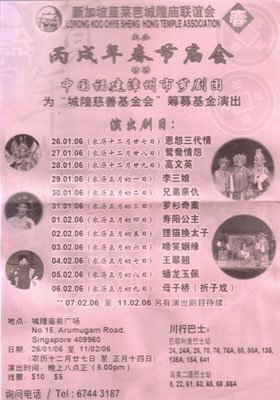
Newsflash - Zhangzhou City Opera Troupe To Perform In Singapore From Today


Zhangzhou City Xiang Opera Troupe will be performing from today till 11 February at Lor Koo Chye Seng Hong Temple (韭菜芭城隍庙) at Arumugam Road, off Paya Lebar Road and behind Geylang Police Station. This is the 3rd time the troupe is coming to Singapore after a lapse of 18 years.

Zhangzhou City Xiang Opera Troupe is a well-established troupe which has produced award winning shows like "The Queen Of Opera" (戏魂), "Legend Of Xi Shi" (西施与伍员) and "The Teacher, The Thief" (三家福). Former actress and currently one of the key figures in the troupe, Zheng Xiuqin, was one of the two first grade actress in this opera genre. Other crew members include artistic director Wu Ziming, who is well-known in the Xiang and Teochew opera scenes local and in China, and composers Chen Bin and Yang Senlin.

The shows the troupe will be staging include "Legend of Li Sanniang" (李三娘), "Muzi Bridge" (母子桥) and "Inside the Forbidden City" (狸猫换太子) as well as some short excerpts like "The Broken Bridge" (断桥) and "Wu Song and Pan Jinlian" (武松杀嫂). Tickets are priced at $5 and $10, and is available at the temple's administration office. For enquiries, please call them at 67443187.