Showing posts with label Xiju. Show all posts
Showing posts with label Xiju. Show all posts
Monday, December 22, 2008
Chinese Opera 3-in-1: The Jade Flying Phoenix
I found this on 56.com recently, about a theatrical performance in China which has got actors from Yueju, Xiju and Kunqu performing together. It wasn't a very new show already, as this video I found was uploaded early last year. This show, titled "The Jade Flying Phoenix", tells the story of Fan Li and Xi Shi after the fall of the kingdom of Wu. In this show, there're 3 pairs of Fan Li and Xi Shi; Zhao Zhigang and Zhao Haiying formed the Yueju pair, Zhou Dongliang and Li Shuxian the Xiju pair and Zhang Jun and Lei Ling the Kunqu pair. I'm curious as to how the producers integrate the elegance of Kunqu, the gentleness of Yueju and the meliodious nature of Xiju into one cohesive theatrical piece, but since no video recording of it is available either on the net or in VCD/ DVD format , I'll just have to keep my fingers crossed for now!

Tuesday, May 16, 2006
Review: The Mute Lady's Lawsuit (Wuxi Opera)
 Title: The Mute Lady's Lawsuit (哑女告状)
Genre: Wuxi opera (锡剧)
Format: Stage opera
Production year: Around late 1990s to early 2000s
Director: Chen Jian
Music: Yuan Yao
Scenography: Yang Yuan
Casts: Zhang Meihua as Zhang Shangzhu, Wang Weihong as Zhang Saizhu, Qian Ke as Chen Guangzu, Yang Longhua as Dai Da, Huang Qiuwei as Madam Zhang, Qin Xing as Zhang Zhong
At first glance...
"The Mute Lady's Lawsuit" is a rather famous show in the Chinese opera scene, and so far, Huaiju opera (Jiangsu), Jinju opera (Shanxi), Bangzi opera (Hebei), Huangmei opera (Anhui), Qiongju opera (Hainan), Xiangju opera (Fujian), Chaoju opera and Cantonese opera (Guangdong) had already staged their own version of the same script. Hence, it would be interesting to see how will Wuxi opera, one of the 3 major Chinese opera genres in Eastern China, make this their own traditional show. This show was staged by Suzhou City Wuxi Opera Troupe.
Synopsis
 This story took place in Yangzhou during the Ming dynasty. There was a Zhang's Residence whereby one of the towers was rumoured to be "haunted", causing unrest among the household members. The "haunting" was actually fake, and the "ghost" living within was a poor scholar by the name of Chen Guangzu. He was betrothed to Zhang Shangzhu, the eldest daughter of the late Master Zhang. Chen used to come from a reputable family, but ever since his parents' death, his family was reduced to poverty. He tried to take refugee with the Zhang's, but Shangzhu's stepmother looked down on the former, an chased him away. Kind-hearted Shangzhu decided to take him in, but had to hide him inside the tower to avoid suspicion.
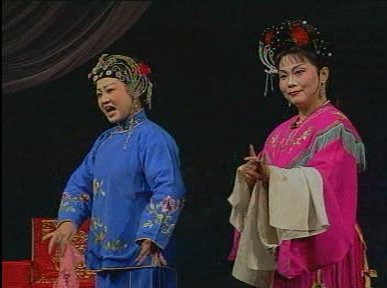 After Guangzu left the Zhang's to pursue his imperial examinations, Madam Zhang tried to force Shangzhu into another marriage. Shangzhu refused and was locked up in the "haunted tower". Not long after, news of Guangzu's promotion as the top scholar reached Madam Zhang and Saizhu's ears. Saizhu, the stepsister of Shangzhu, had always dreamt of becoming a nobleswoman one day, decided to forge her sister's identity and marry Chen. In order to prevent unexpected twist of events in future, Madam Zhang decided to kill Shangzhu by ordering her retarded son Dai Da to burn down the "haunted tower".
 Meanwhile, loyal servant Zhang Zhong had revealed the truth about Saizhu's plot to Shangzhu. Shangzhu was shocked by the deeds of her stepmother and stepsister, and decided to sue them in the imperial city. However, before she could sneak out, the tower burst into flames. Shangzhu escaped from the clutches of Death by jumping off the balcony of the tower, but became crippled. Dai Da realised that he had been tricked into burning down the "haunted tower", and decided to nurse Shangzhu back to health in a secret cave in the garden. With the help of Zhang Zhong, Dai Da piggy-backed Shangzhu all the way to the imperial city to look for Chen.
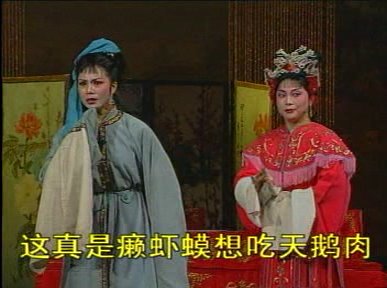 Saizhu got news of their arrival in the imperial city, and hence tricked them back to her residence.In front of her stepsister, Saizhu pretended to be remorseful for her actions, and tried to beg "forgiveness" with a toast of wine. Shangzhu was not in the mood to drink, and Dai Da drank the wine on her behalf. Little did they know that the wine has been drugged, and that Saizhu had actually intended to poison Shangzhu. Dai Da was poisoned to death in the end, and Saizhu muted Shangzhu by stabbing her in the neck repeatedly with a hairpin. She even crushed Shangzhu's fingers so that she could neither talk or write in court.
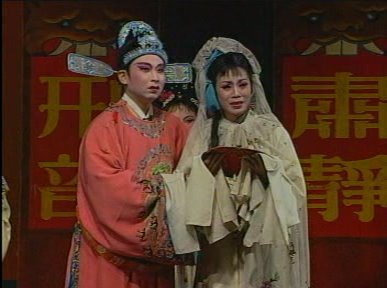 Despite her disabilities, Shangzhu was determined to sue her vicious stepsister. She was finally granted entry to the magistrate's court, and the magistrate was none other than Chen Guangzu. Chen, who had actually not seen Shangzhu's true face previously (they always meet in the dark), was shocked with the close resemblance of Shangzhu to his "wife". At this juncture, Saizhu turned up and accused Shangzhu for being a crasy woman and demanded her to be executed at once. Chen began to doubt the identity of Saizhu, and she was nowhere close to the elegant and gentle Shangzhu he once knew. Loyal servant Zhang Zhong turned up pleading innocence for Shangzhu, and after gathering all her strength, Shangzhu finally managed to speak. She revealed the entire truth to Chen, and the latter was shocked. He then sentenced Madam Zhang to life-imprisonment and Saizhu to be executed immediately.
Shangzhu was finally reunited with her loved one, but she decided not to don the rainbow robe and phoenix crown which was bestowed to her, as she wished to mourn three years for her poor brother...
Review
 As far as the script is concerned, it lacks originality, as I vaguely remember the Huaiju and Xiangju version of the same show beared the same dialogues and lyrics (but of course with some differences to suit the dialects). Like typical traditional shows, there were obvious flaws in the logic of the show, but were not resolved. Like in scene 2, where Madam Zhang forced Shangzhu to marry a high-ranking official, the script doesn't explain why the former had done that. Normally a stepmother will want the best for their own children first, and a high-ranking official sounds like a good "catch", so why didn't she want to "reserve" the marriage for Saizhu instead? Unless he has got other undesirable traits, then it would be another story, but it wasn't mentioned. And point in the same scene was Saizhu was so decisive im marrying herself to Chen when she heard that Chen had became a top scholar. However, earlier on in the scene, she was dreaming of being the Emperor's concubine, and even become the head of the concubines. The sudden drop of "goal" was too abrupt and awkward.
The music was another awkward issue. It is very clear that the music were all pre-recorded and then actors sing to that on stage. This was made more obvious by the difference in sound quality of live percussion used in non-singing/ non-music parts of the show. The casting for this show were average. Of all the actors, only Zhang Meihua, who took on the role of Zhang Shangzhu, really caught my attention. She was graceful on stage, looked great, and could sing well. The other actors' singing were not bad too, but did not fare as well in other aspects of their performance. For Qian Ke (Chen Guangzu), he lacked emotions, and his shen duan was average. Wang Weihong's rendition of the vicious Saizhu was good, but she seemed a bit too old to be the younger sister of Shangzhu. In fact, it seemed like none of the actors in this show are young.
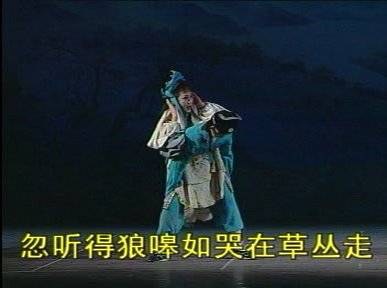 Back to Zhang Meihua, though her performance in general was good, her performance in scene 6 ("Journey to the Imperial City") was disappointing. This is the essence of the show, regardless of the genre, as the actor taking the role of Shangzhu has to perform solo with a "piggy-back doll". This is no easy feat, and the actor will have to act 2 roles simultaneously; a dan from waist up and a chou from waist down. Zhang Meihua's huadan gestures were good, but when it comes to chou movements, it was really average. The quality of this scene was aggravated by the quality of the "piggy-back doll", as the doll was already in a bad-state, and looked more like a zombie, rather than a life-like man.
On the whole, I feel that this show could have been better executed, but too bad too much of the original script was preserved. It might be good to maintain the traditional aspect of the script, but I think some irrelevant and illogical parts still must be changed. Time has changed, and the audience's level of thoughts has changed as well, so do not expect modern audience to readily accept whatever you throw at them!
Ratings
Script
Music
Scenography
Casts
Final rating
Sunday, April 30, 2006
Just One Look : The Look That Wowed Audiences 3
In this third part of the series, I've attached a clip of Wuxi opera, "The Pearl Pagoda" performed by the Wuxi City Xiju Opera Troupe.
"The Pearl Pagoda" tells the story of a poor scholar Fang Qing, who was actually the descedant of the late primt minister, was shunned by her paternal Aunt when he turned up on his uncle's birthday feast to seek financial assistance. She even mocked him by saying she would carry an incense altar over her head to welcome him if he ever make it big in future. Fang Qing felt insulted and was about to leave but was stopped by his cousin Chen Cui'E. Miss Chen had always liked her younger cousin, and in order to aid Fang Qing, she decided to present her family heirloom, the Pearl Pagoda, but disguised as a box of cakes. Miss Chen's father found out about the whole incident and decided to chase after his nephew and had his daughter engaged to him. On his way back home, Fang Qing was was robbed of the Pearl Pagoda not long after by a robber and left to die in the wilderness. However, luck was on his side as he was later saved and topped the imperial examinations 3 years later. He decided to return to the Chen's residence under disguise as a examination drop-out to test his aunt. Fang Qing's aunt realised her follies, and accepted Fang Qing as her son-in-law to compensate for her short-sightedness.
Featured here is the second scene of the show, "Fang Qing Meets His Aunt". Acting the role of Fang Qing and Fang Duohua (Fang Qing's aunt) are Pan Peiqiong and Guo Zhihong respectively. The actor of particular interest to me in this scene is Guo Zhihong. Her portrayal of the snobbish and mean aunt was very comical, yet not diminishing the grace and airs of a nobelwoman. Especially so since this is first time she has been taking on a laodan role! (She used to be a xiaodan and huadan of the troupe)
Subscribe to:
Posts (Atom)