Monday, November 13, 2006

Yueju Crossover part 2

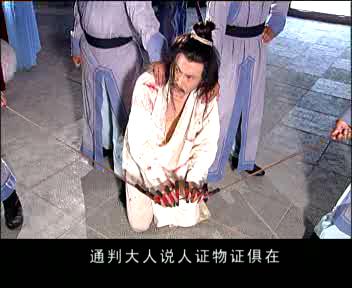
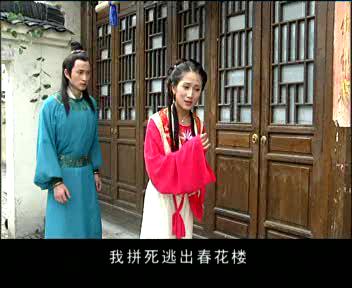
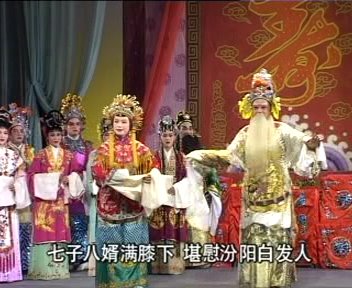
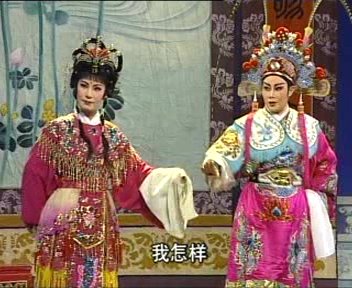
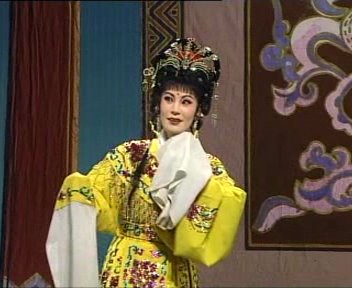
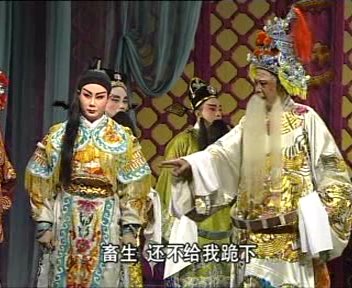
The following 2 clips features Shan Yangping and Huang Hui from Shanghai Yue Opera Company singing excerpts from "Romance of the Red Mansion" and "The Righteous Yan Lanzhen" respectively.


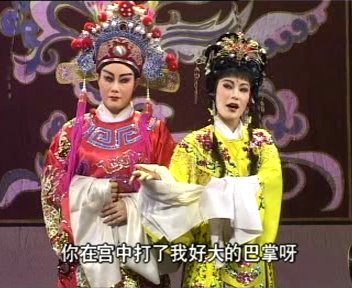
Shan Yangping is a Wang-style Huadan, it's signature characteristic being frequently sliding between low and high notes in the same song, and that sometimes at the end of each verse, the notes would be sung in a cadenza. Huang Hui, on the other hand, is a Lu-style Xiaosheng. This style of singing doesn't require one to sing in a wide vocal range, but is still able to captivate audience with it's simplicity and elegance. In this next clip from "Legend of He Wenxiu", Shan Yangping took on the lead role of "He Wenxiu", originally acted by Yin-style Xiaosheng and Huang Hui took on the role of Wang Lanying, originally acted by Yuan-style Huadan. Two other supporting roles were featured in this clip, Madam Yang impersonated by Bi-style Xiaosheng Ding Xiaowa and Yang Jinding impersonated by Xu-style Laosheng Jin Hong.


My verdict:
I have no doubts about Shang Yangping's rendition of a xiaosheng, since she had acted the role of Meng Lijun (who had to disguise herself as a male to save her husband-to-be) for over a 2 decades. I was pleasantly suprised that her acting as He Wenxiu was more "manly" compared to Meng Lijun. However, her singing was not within my expectation, as her voice was afterall, not "nasal" enough to sing the Yin-style. Huang Hui's rendition of Wang Lanying was not bad; her singing was close to Yuan-style, and her shen duan is good. However, her looks was a bit weird. I've seen her crossdressed as Laodan before in a crossdress rendition of "The Jade Hairpin", but she didn't look that strange at that time! I guess it could be her makeup, which spoilt her otherwise delicate looks. One thing I must comment is that Jin Hong's impersonation of Yang Jinding was out of my expectation. Jin Hong was known for her villian or strict-faced roles, but I could never imagine her to act as a cute and innocent girl like Yang Jinding.

My ratings:
Shan Yangping's singing

Shan Yangping's acting

Shan Yangping's entertainment value

Overall rating for Shan Yangping


Huang Hui's singing

Shan Yangping's acting

Shan Yangping's entertainment value
Overall rating for Shan Yangping

Yueju Crossover part 1

For those who love Yueju opera, it shouldn't take long to recall what shows and roles Wu Fenghua, Qian Huili or Fang Yafen featured in. However, are you able to visualise them "crossdressing", that is, switch over to act the opposite hang dang in which they were not specialised in?

The first two clips here features Xu Ming from Hangzhou City Yue Opera Troupe singing an excerpt from "The Butterfly Lovers" and Zhang Ruihong from Shanghai Yue Opera Company singing an excerpt from "Female Premier Meng Lijun".


They were trained as xiao sheng and specialised in the Fan-style of singing, which is famous for it's ornamented and prolonged ending notes for each line. However, in this next clip here, they took on the role of Madam Chen and Sun Gumei respectively from the show "The Annulment". The role of Madam Chen, a mix of was to be taken onLaodan and Caidan, was to be acted by a Caidan actress while the role of Sun Gumei, a Huadan, was to be acted by a Fu-style Huadan actress.


My verdict:
Xu Ming's rendition of Madan Chen was really comical, and it's hard to imagine that she was in fact a Xiaosheng if you had not known her before. Zhang Ruihong's initial appearance on stage made me laugh, because I thought she looked weird, but her imitation of Fu-style singing was quite close to how Fu Quanxiang (the founder of this style) sang. However, her shen duan was too stiff for a Huadan, and she seemed a bit hunchedback at times. These made her performance weaker in comparison to Xu Ming.

My ratings:
Xu Ming's singing

Xu Ming's acting

Xu Ming's entertainment value

Overall rating for Xu Ming


Zhang Ruihong's singing

Zhang Ruihong's acting

Zhang Ruihong's entertainment value

Overall rating for Zhang Ruihong

Tuesday, October 03, 2006

Review: The Case of Taiping County's Illegal Salt Syndicate (Shaoxing Yue Opera)

Title: The Case of Taiping County's Illegal Salt Syndicate (太平私盐案)
Genre: Shaoxing Yue opera (越剧)
Format: Opera drama series
Production year: 2001
Director: Zhang Zhiming
Script: He Renshan, Qian Linsen
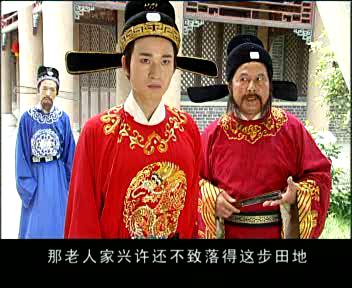
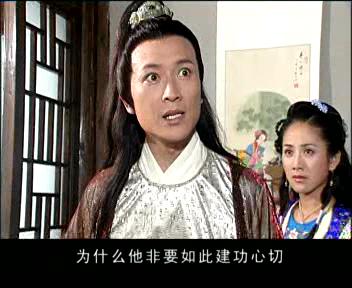
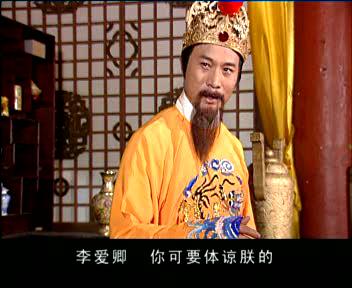
Casts: Lou Yonghuan as Li Pu (voice-over by Zhang Weizhong) and Li Yu, Tang Ji'na as He-hua (voice-over by Chen Fei), Zhang Gong as Sun Jizong, Hua Weiqiang as Cai Bao, Shu Jinxia as Mrs. Cai, He Juanjuan as old Mrs. Cai, Zhang Weizhong as Emperor (cameo appearance)


At first glance...

This 4-part opera drama series is an award winning video production by Zhejiang Literature & Arts Audio-Video Publishing House shot in 2001, and performed by Zhejiang Province Yue Opera Company. Although the male and female leads of this show were relatively new actors from Zhejiang Province Yue Opera Company and Hangzhou City Yue Opera Company respectively, this show was still a star-studded one. Celebrity actors like Zhang Weizhong and Chen Fei lent their voices to the main roles, while experienced actors like Zhang Gong, He Juanjuan and Shu Jinxia took on other very minor roles.


Synopsis

The district officials of Taiping County were rumoured to be involved in a big case of illegal salt trading. Although the imperial court had sent three inspectorates to investigate, they could not find any evidence against the craft district officials, who were actually in cahoots with the local businessmen. One day, Cai Bao, a junior official in Taping County, discovered their secrets, and was thrown into jail, in an attempt to silence him. At this point of time, news had it that the imperial court has sent it’s 4th inspectorate, Li Pu, to Taping County. Li Pu was once a poor scholar who had recently topped the imperial examinations. Being full of aspirations, he volunteered to take on the task to look into the case. Li Pu’s twin brother, Li Yu, became his chief constable.

Li Pu and Li Yu may be twins, but their characters were not totally the same. While Li Pu was more matured and level-headed, Li Yu was more simple-minded and impulsive. Sun Jizong, the head of the illegal salt syndicate, made use of Li Yu’s weakness against Li Pu. He sent a beautiful woman by the name of He-hua to get close to Li Yu, and tried to brainwash him. Li Yu was taken in by He-hua’s words, and was made to believe that by standing in his brother’s way to justice was the only way to save Li Pu from harm. He was even tricked into silencing Cai Bao, the key witness to the case. Li Yu subsequently realised his follies, and decided to turn himself in.

While turning himself in, Li Yu handed over an accounts book which was a very important piece of evidence against the district officials and the local businessmen. However, there was a big hurdle for Li Pu; Sun Jizong’s grand eunuch brother knew about Li Yu’s matter, and in order to save his own brother, he counter-accused Li Pu for covering up for Li Yu. The case was brought up to the emperor, and taking into consideration of Li Pu and grand eunuch Sun’s merit, the emperor decided to pardon both Sun Jizong and Li Yu. Li Pu, however, insisted that both culprits be punished in order to uphold justice. The emperor had no choice, but to pass the death sentence to Sun Jizong and Li Yu.

Review

Personally, I wasn’t really a fan of opera drama series, as I feel they simply lack the magically feeling of a stage opera. One of the key problems was that opera drama series had to adapt to the style of TV drama, and hence had to do away with a lot of Chinese opera essence, and this in turn makes the show less “operatic”. Although the plot of the show was not too bad, the shooting style of the show was nothing much to praise about. In fact, there were quite a number of scenes which I find very awkward. Although the main actors for this series were professional actors, they just do not seemed at ease acting in front of a camera, and in some singing scenes, they simply walked to and fro in front of the camera while singing, and doing some simplified operatic gestures. If I had not known their names and identity, I would have thought that these actors were just average actors not trained in the field of Chinese opera!

For the cast, I feel that the supporting actors were actually much stronger than the leading actors. Lou Yonghuan of Zhejiang Province Yue Opera Company took on the roles of Li Pu and Li Yu. In order to distinguish between the two different roles, the voice and singing of Li Pu was dubbed over with Zhang Weizhong’s voice (he made a cameo appearance as the emperor in this show), while Lou Yonghuan spoke and sang the parts of Li Yu. In my opinion, Zhang Weizhong used to be a good singer in the 80s, but in this show, his voice seemed to have deteriorated a bit. However, I still find his voice quite good, as compared to Lou Yonghuan’s own singing. Tang Ji’na from Hangzhou City Yue Opera Company took on the role of He-hua, but her dialogue and singing parts were all dubbed over by Chen Fei. Both Lou Yonghuan and He-hua, though looked good on stage, was only average in terms of acting. Experienced actor Zhang Gong, who took on the non-singing role of Sun Jizong in the show, performed much better as a baddie. The actors taking on the roles of the district officials were average, but they had got the sinister feel in their acting while made me feel like slapping them.

As for the script, it was well-written with quite a bit of twists along the way. However, the first two episodes of the show were too slow-moving, and I just couldn’t focus on the show. The last two episodes were much better, with a faster tempo. I think the show could even be condensed into a 3 part series.

On the whole, I find this show just average. There were some nice parts here and there, but there were many other scenes which I think were not well done. If not for the celebrity cast, I think this show would be more a flop.

Ratings


Script

Music

Directing

Casts

Final rating

Sunday, September 24, 2006

Chinese Opera DIY: Making A Chinese Opera Wig From A Conventional Wig

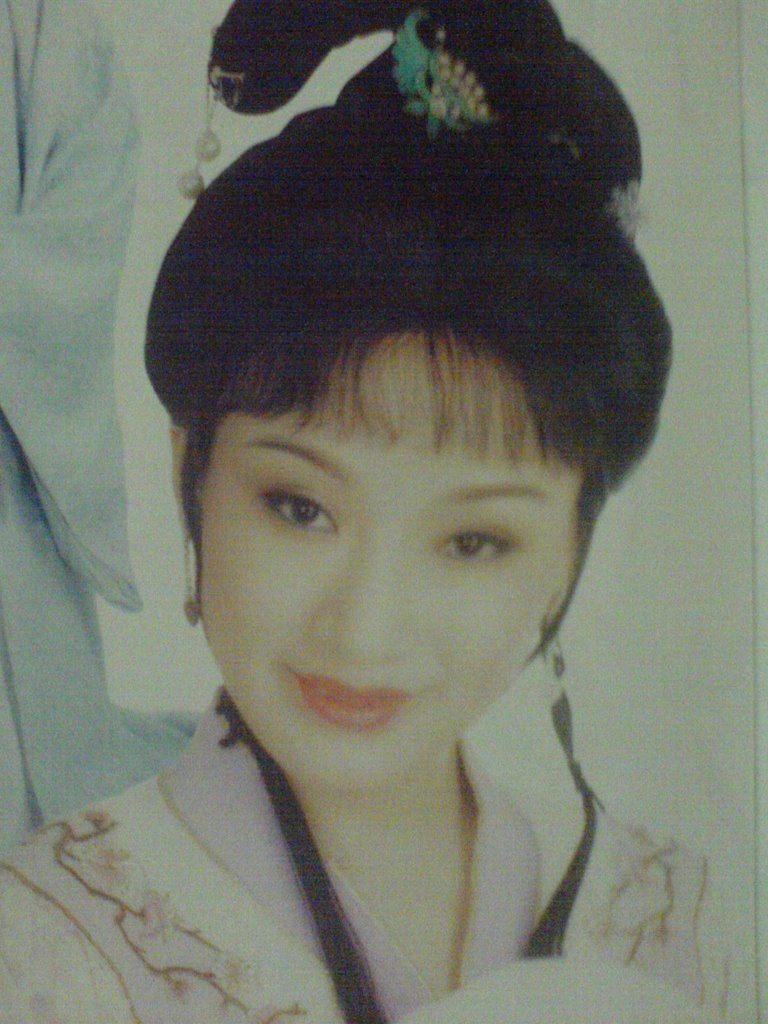
On the Chinese opera stage, wigs are used extensively for female roles, and sometimes for male roles too. Chinese opera wig is already hard to get in Singapore due to the size of the potential market, and what you can often get locally are the badly styled ones. Therefore, many Chinese opera artistes would fly over to Taiwan or China to buy, but it is not cheap, even if you do not take into consideration the cost of the air ticket.

So what can an aspiring actor with a small budget do to own a Chinese opera wig? Well, he or she can make them out of a normal wig! Of course, you can't use any wigs you find in the wig shops just as they were because they looked way too modern, even for those plain straight ones. You would still have to style them first. There are hundreds of different kinds of wigs available in the market, and how should one go about choosing it? Let's start off from the fundamentals.

In vague terms, wigs can be classified as synthetic wigs and real hair wigs. As the name implies, synthetic wigs are made of synthetic fibres while real hair wigs are woven from real human hair. A real hair wig can cost many times more than that of made of synthetic fibre, but you can style it over and over again, whereas synthetic fibre wigs are not really meant to be restyled, and excessive or rough combing can actually damage the fibres permanently. (You can check if the wig’s made of real hair or synthetic fibre by snapping a strand of the hair; if it's real hair, it should just snap into two, whereas synthetic fibre would stretch, snap and shrink into a frizzy strand.) For economical reason, a synthetic wig would do just find.

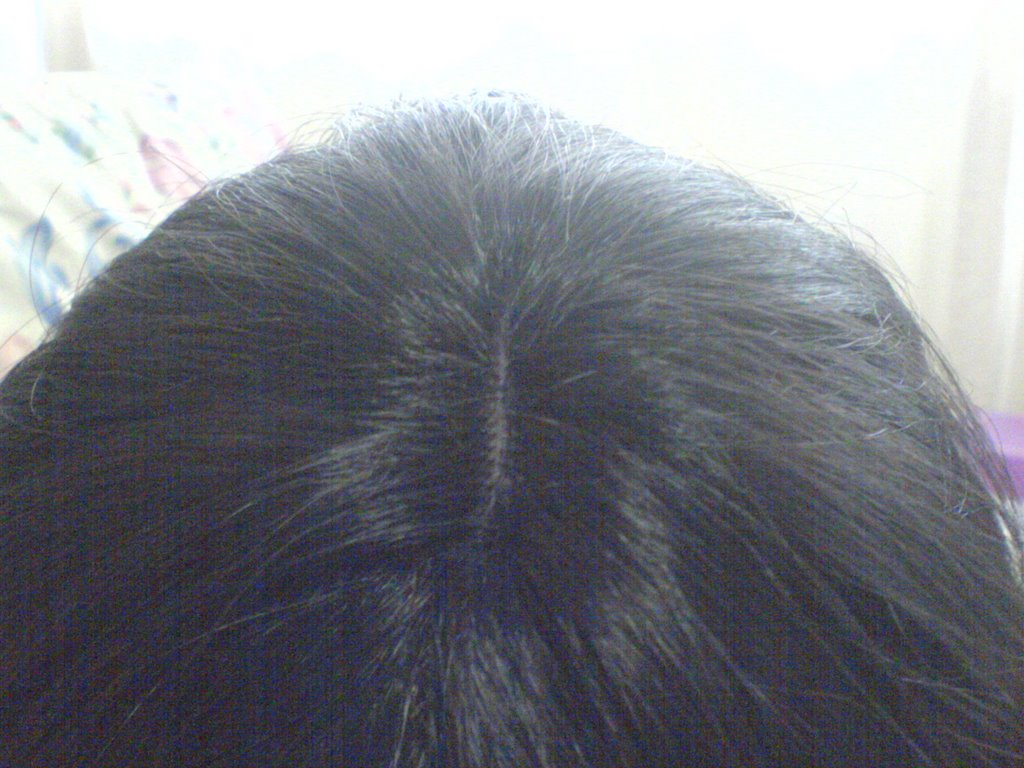
The next thing we should look at is the style of the wig. The wig, obviously, would have to be long (at least till chest level after wearing it), straight and black. One important aspect to take note is that the wig must not have any fringe, even though you may want your completed wig to spot one. The reason is because we would need to comb up the crown area of the wig up into buns to look like those in the Chinese opera wigs. If there is already a fringe on the wig, the hair on the crown area could be too short to be combed up. If you really want the final wig to spot a fringe, you should get the fringe cut only after styling. Another thing to take note is that the wig should be at least has a monofilament crown. A monofilament is a term to describe how the inside of a wig is constructed. One of the features of a monofilament wig is to allow the wig wearer to part their wig in any direction without revealing their real hair (or lack of) underneath. This is especially important, because we might just reveal the wig's netting around the area where you comb up the hair, and it would look very ugly.


A monofilament crown wig showing off some "skin" beneath


A monofilament crown wig with portion of hair combed up, not revealing whatever beneath the wig


A non-monofilament crown wig with portion of hair combed up, revealing whatever beneath the wig


Besides the wig, we should also have some rats ready. No I do not mean those creatures with 4 legs that go munching through all your electrical cables. These "rats" are actually stuffed hair buns which are used to create volume during hairstyling. Sad to say, rats are out of fashion in Singapore already, and I can't seemed to find any locally anymore. However, one can still make one themselves by stuffing crepe hair into fine black stocking. Of course you do not need rats as long as a stocking. A rat about one-third that of the size of a fist should be big enough, and depending on the style you want to make, you would need about 2 to 3. You may consider making a few more of various lengths and density, which can be used to add height and volume of your wig for different roles.

Other things we need to get in advance are hairpins, black rubber bands, and a foam wig stand. First sit the wig securely over the wig stand, then part a fraction of the hair on the crown section of the wig, and comb them to the front. Secure 2 rats on both sides of the crown, near the temple region, and comb the parted hair neatly over it rats. Remember to leave some of the hair for the fringe, if you intend the final wig to spot one. After combing the hair over the rats, ensure that the rats were totally covered. Tie the combed hair behind the rats in a way that the hair is wrapped around the rats tightly with no loose hair coming out in any directions, or the rats being exposed. You might have to redo these steps over and over again, in order to try to find the correct position for the rats, as well as the correct size and shape for your buns. Now that you have 2 buns on the wig, secure the position of the buns onto the wig with hair pins.


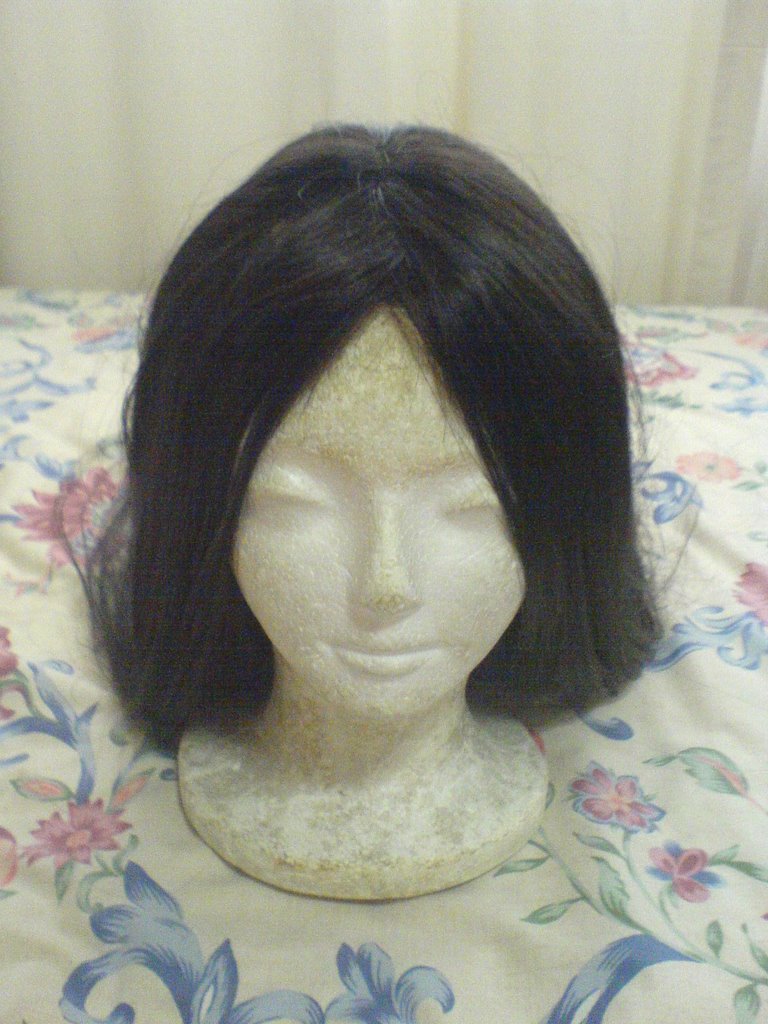
A "raw" wig on wig stand


Parting a portion of hair from the wig and positioning the rat


Combing the parted hair neatly back over the rat


Tie the combed hair behind the rat into a tight bun


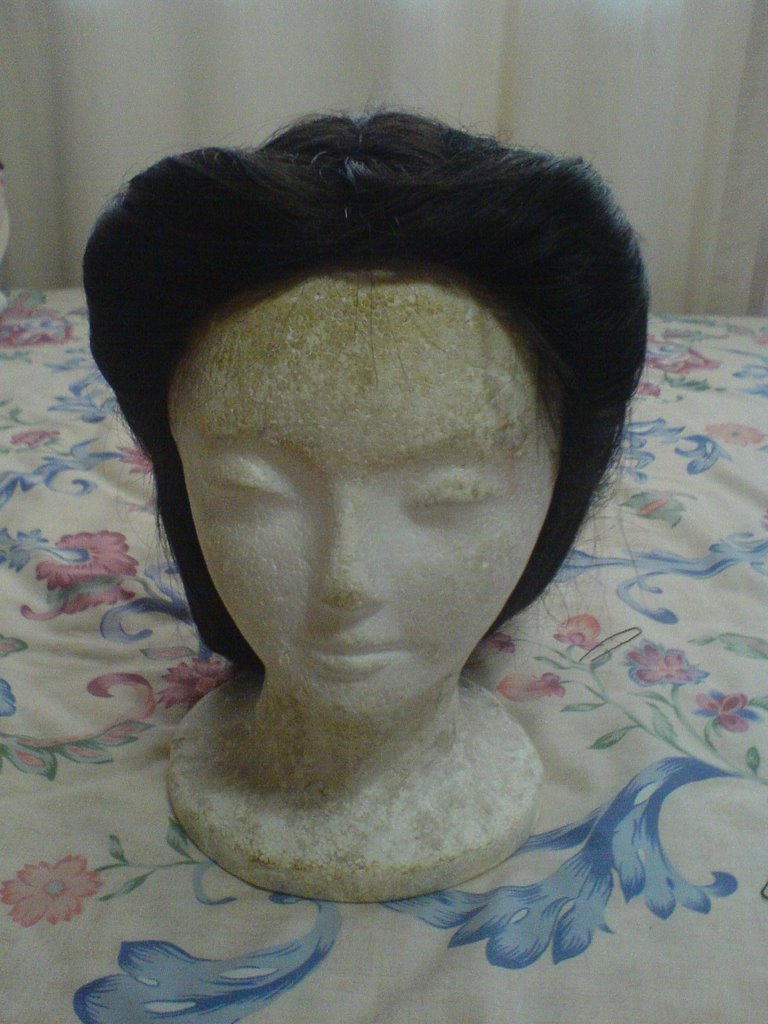
Half finished wig with one bun each on both sides


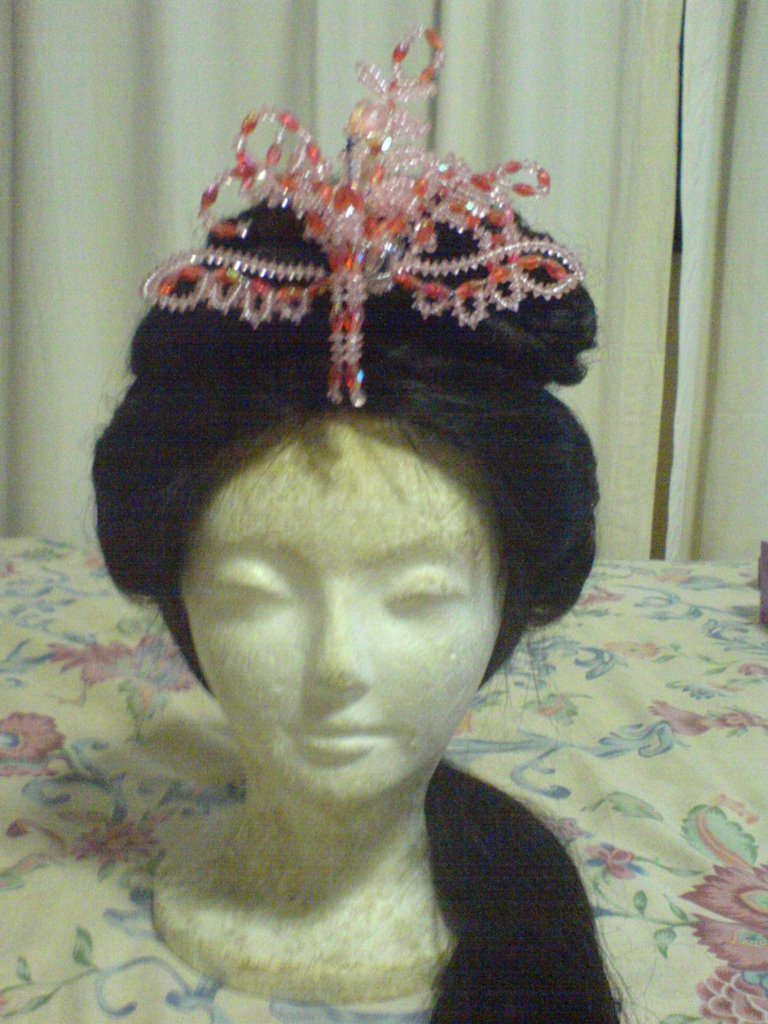
There you are, your wig is almost done! To make the wig even neater, you can pleat up the two tassels of hair behind the bun and secure them in an obscure position, while tying the hair behind with a ribbon into a bunch. If you have left a portion of the front hair for the fringe, remember to have it cut and style by some professionals! Do not attempt to do it on your own unless you're very experienced with it, or you may just ruin the fibres (especially so if it's synthetic wig).


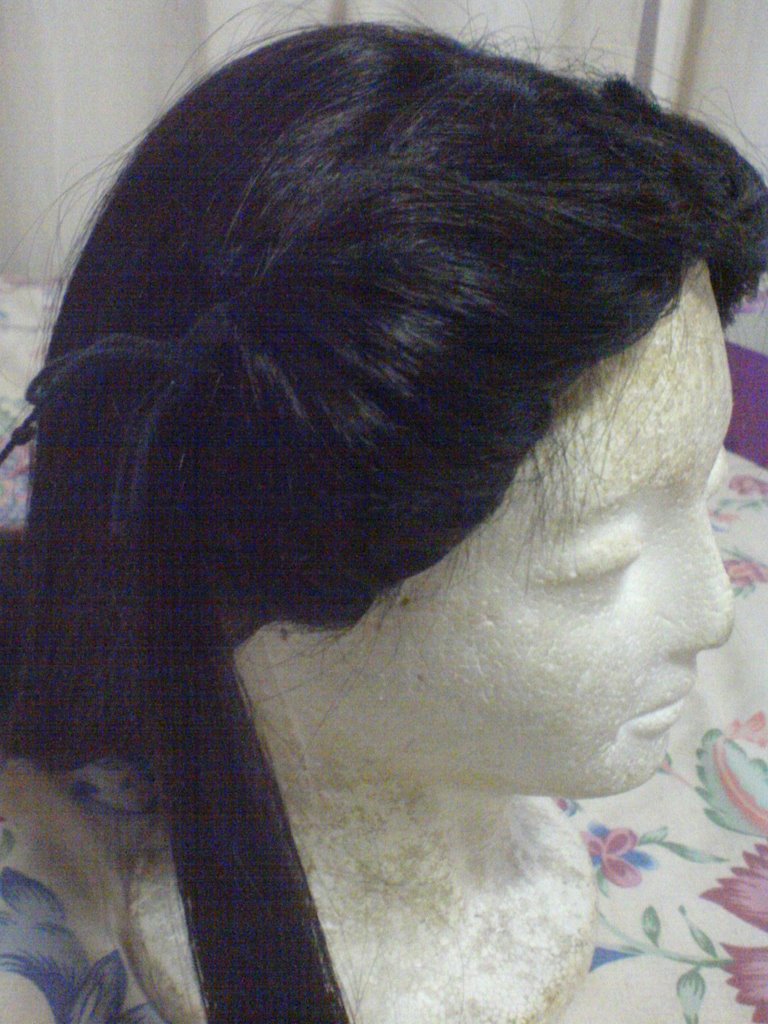
Back of hair neatly tied into a bunch (completed)


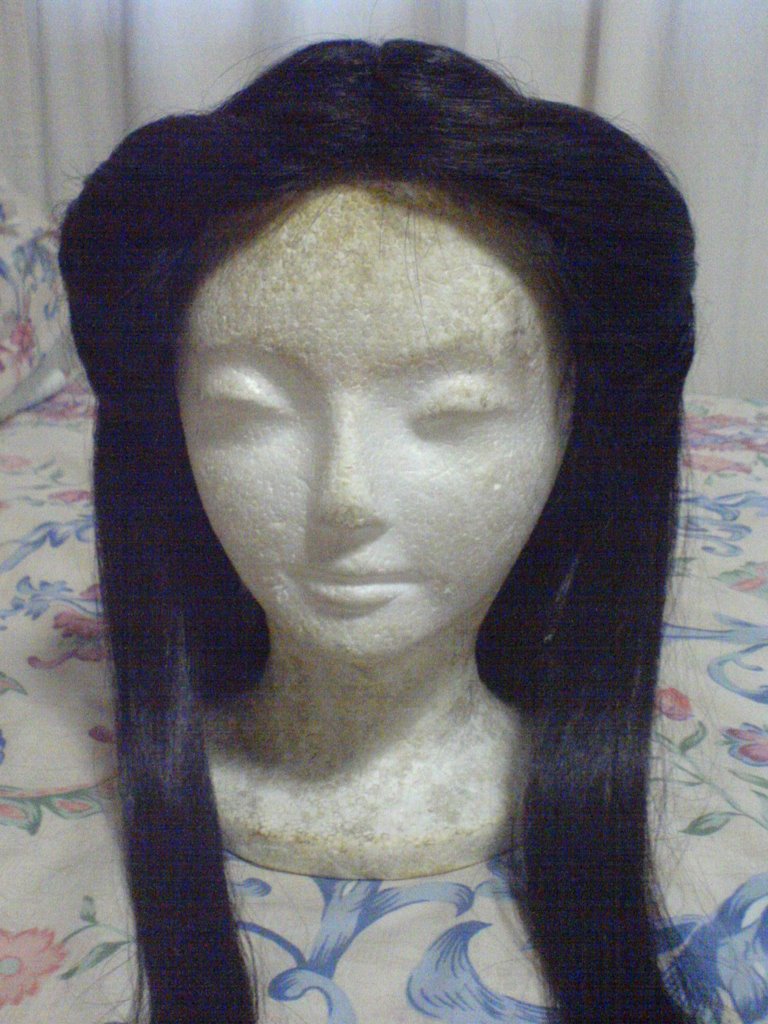
Completed wig with additional rats attached and secured to add volume and style for character portrayal


Previous wig with additional hair acceossories

Tuesday, August 08, 2006

Review: The Arrogant Princess (Teochew Opera)

Title: The Arrogant Princess (打金枝)
Genre: Teochew opera (潮剧)
Format: Stage opera
Production year: Around late 1990s to early 2000s
Director: Chen Wei
Music: Chen Dengmou
Scenography: Lin Xichong
Casts: Xu Shu'e as Gui Ai, Hong Liqing as Princess Junrui, Chen Lianzhong as Emperor, Lin Yanfang as Empress, Lin Roujia as Guo Ziyi

At first glance...

"The Arrogant Princess" is a well-known folk story which had been acted out in various Chinese opera genres. The highlight of the show lies in the scene whereby the Princess consort gives the Princess a tight slap for failing to observe her role as a filial daughter-in-law, something which in ancient times is a taboo act to be carried out to a member of the royal family. This show was staged by Jieyang City Chaoju Opera Troupe .

Synopsis

On the 70th birthday of Guo Ziyi (Duke Fenyang), all his sons, daughters and their spouses turned up to celebration, except for the wife of Guo Ai, Guo Ziyi's sixth son. Guo Ai's wife was Princess Junrui, and she refused to turn up as she believed that it was against the norm for members of the royal family to pay respect to their subjects. Guo Ai's fifth sister-in-law was a straight-forward person, and she mocked Guo Ai for bragging earlier that the Princess would sure come. This angered Guo Ai greatly, and stormed back to his residence to reprimand the Princess.

Meanwhile, in the residence of the Princess consort, the Princess was feeling moody with Guo Ai not by her side. When she heard that her consort had returned, she asked the palace maids to hang up the red latern. This hanging of red lantern was a practice of the imperial palace, and the red lantern served as a granted permission to enter the room. On seeing the lantern, Guo Ai grew more furious, and he had the lantern smashed. The Princess was suprised by Guo Ai's action, but did not realise that it was her who had made him angry. Guo Ai confronted the Princess for failing to turn up for his father's birthday celebration, and she insisted that she was not in the wrong for not bowing down to her subject. A heated argument between the couple soon broke out, and Guo Ai gave the Princess a tight slap in the end.

Unable to stomach the humiliation, the Princess decided to lodge a complain to the Emperor, and even made up stories that Guo Ai had abused her with she suffered injuries all over her body. The wise Emperor knew this is just a small squabble among the young couple, and decided to give the Princess a scare by pretending to get furious and "sentence" the consort to death. This shocked the Princess greatly, and she regretted her earlier actions. However, despite her pleadings, the Emperor was determined to pass the sentence.

Meanwhile, Guo Ziyi had found out about what Guo Ai had done. He was furious, and had him arrested and brought to the imperial court to surrender to the Emperor. The Emperor was impressed by Guo Ziyi being impartial in this matter. He forgave Guo Ai on the spot, much to the relief of Guo Ziyi. However, he still reprimanded Guo Ai for losing his cool and showing defiance towards the Imperial rules. The Emperor then led Guo Ai back to the inner palace to meet the Princess. After much coaxing from the Emperor and Empress, Guo Ai and the Princess fnally patched up. The Emperor even gave Guo Ai permission to use his hand again if the Princess ever gets wilful again. All's well ended well, and the young couple went over to Duke Fenyang's residence after their reconciliation to pay their over-dued respect to Guo Ziyi.

Review

For traditional shows like this, I do not expect much from the script, as long as they do not go out of point, it is acceptable for me. For this production, the plot was concise enough, without having to go into unneccesary details like what some other productions I've seen before. Jieyang City Chaoju Opera Troupe is a relatively unknown troupe to me, but the standards of their performance is quite good. The 2 leads managed to portray the role of Princess Junrui and consort Guo Ai well. One particular point that I want to bring out is the role of Princess Junrui. This role is rather complex; she is wilful, but not in the sense of being spoilt and stuck-up. To my understanding, she is a lady who is well-taught in rules and customs, just that she failed to apply them in good use, and in this case, paying respects to her in-laws. Hong Liqing managed to capture the feelings of the Princess correctly, but it'll be better if she could "act cute" a bit more. Xu Shu'e's performance as Guo Ai is competent. She managed to balance the serious side of a Princess consort and the imprudent side of young Guo Ai well, without over-doing in either way. The other supporting roles were acted out well too.

As for the costumes and character portrayal, there were areas which I don't quite fancy. First, most of their costumes are actually sewn with sequin, making the design of the costumes look harsh, and at times "out-of-fashion". As for character portrayal, the actress assuming the role of Guo Ziyi's wife looked too young to me. When standing beside the wrinkle-faced Guo Ziyi, Madam Guo's face was too smooth, and her hair were all black. She should be of the same age as Guo Ziyi! Another character I wasn't too satisfied with it's portrayal is the role of Empress. Somehow the overall packaging just doesn't give me the feeling that she's the Empress, although she wears a big phoenix hairpiece on her head, and her costume was embroided with phoenixes.

I like the way the show was directed. There is a particular segment of the show which I rather like, whereby after the young couple patched up, Guo Ai invited the Princess pay respects to his father, but the Princess "refused", and Guo Ai "threatened" to slap her again. Of course, Guo Ai did not land his hand on the Princess again this time round. It's a lovey-dovey act which makes their reconsiliation look more complete. Most other productions only ended at the point where the Princess and her consort patched up. Another part I like is the part whereby the Emperor gave Guo Ai the permission to use his hands on the Princess if she were to become wilful again, and Guo Ai showed the Princess his fist to show his dominance over her.

On the whole, I feel that this show is not too bad. However, if not for the cast and the director's directing sense, I think this show would be a bore to watch.


Ratings


Script

Music

Scenography

Casts

Final rating